Understanding Automation: A Framework for Autonomous Capabilities
Autoworklet Learning Series
What is Automation?
Automation will be the single largest disrupter to businesses over the coming decade. For many organizations, next-generation automation will be the primary mechanism through which Artificial Intelligence (AI) actually impacts their day-to-day operations.
But what does "automation" actually mean?
It's a simple question, but a complex answer. Automation, like AI, is a very broad term. And thinking about it at a broad level will stop you from understanding how it can be adopted to transform your business.
We need a better way to think about automation.
This isn't an academic exercise. Understanding the costs, complexities, and benefits from each level of automation helps you to successfully apply automation to your business. You wouldn't use a power drill to fix the hinge on your reading glasses, nor would you use a tiny screwdriver to drill for oil. Choosing the right tool—the right level of automation—is paramount.
So, how can we better understand automation? Much like the Society of Automotive Engineers (SAE) defined levels for autonomous driving (from Level 0 - no assistance, to Level 5 - full self-driving), we can establish a similar framework for next generation computer automations. Using this framework, you can better diagnose your needs, evaluate solutions, and build a coherent Automation Strategy.
Inspiration from Driving: Understanding the Spectrum
To grasp the concept of automation levels, let's look at a familiar example: autonomous vehicles. SAE International established a widely recognized standard (J3016, for standards enthusiasts) defining six levels of driving automation.
This framework clarifies the increasing capabilities of the vehicle and the corresponding decrease in the need for driver intervention at each stage.
- It starts at Level 0 (No Automation) with fully manual control.
- Early levels (Level 1-2) offer driver assistance features like adaptive cruise control or lane keeping assist. The human is still driving.
- Intermediate levels (Level 3) allow the car to drive itself under specific conditions, but the human must be ready to take back control (Conditional Automation).
- Higher levels represent systems capable of handling the entire driving task without human oversight in defined operational domains (Level 4 - High Automation) or everywhere under all conditions (Level 5 - Full Automation).
Crucially, there are benefits and costs at each level, and one level isn't inherently "better" than another in all situations.
Simplistically, one might exclaim, "Level 5 is the best! Let's just implement that everywhere!" While the enthusiasm is admirable, this perspective overlooks critical realities. Firstly, it doesn't exist. True, robust Level 5 technology suitable for all conditions isn't commercially ready yet. Reliability, safety, and universal applicability remain significant hurdles, and likely will for years or decades. Secondly, even when technically feasible, the cost of sensors, compute power, and complex systems required for Level 5 might make vehicles prohibitively expensive for mass markets. Thirdly, it might simply be overkill for many needs; many people enjoy driving or only require assistance in specific situations like traffic jams or long highway stretches.
Does this mean vehicle automation is useless below Level 5? Absolutely not! It means we must be nuanced. Consider the lower and middle levels. Features like intelligent lane assist, autonomous emergency braking, and blind-spot warnings make daily commutes substantially safer and less stressful. They use automation to enhance parts of the driving task, not necessarily replace the driver entirely. While this won't suffice for a fleet of fully autonomous shipping trucks, it delivers immense value to the average driver.
This leads us to a vital principle applicable across all automation domains: Pick the Right Level for the Right Application.
Picking the Right Level for the Right Application
Each level of driving autonomy opens opportunities for specific applications. Autonomous taxi services operating within a geographically restricted area (geofenced) might target Level 4. Major automakers producing cars for the general public focus heavily on refining Level 1 and 2 features for safety and convenience, while cautiously introducing Level 3 capabilities in premium models.
This structured approach provides a useful analogy as we now explore similar levels in the realm of software and workflow automation.
The Levels of Automation
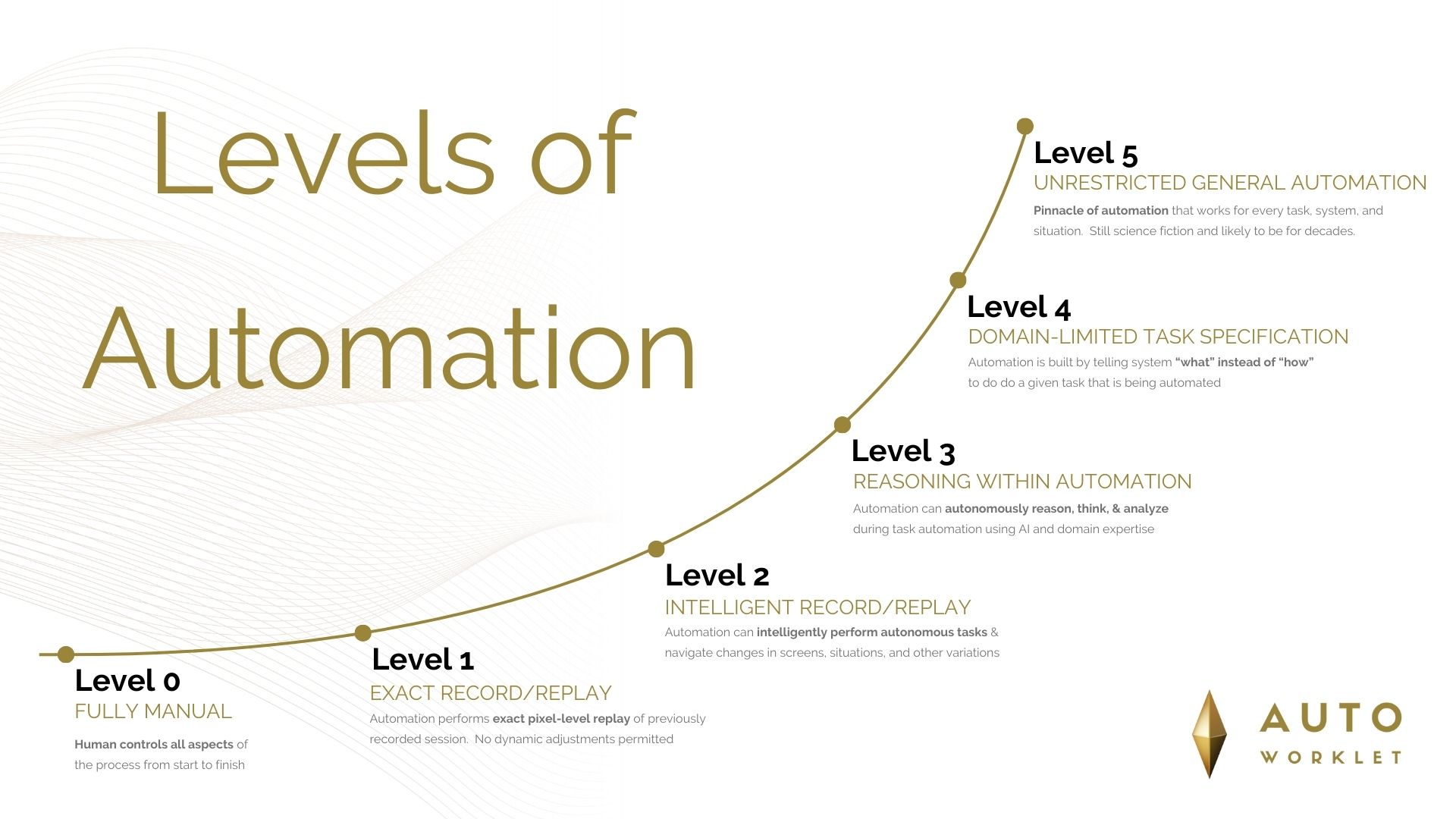
Based on this inspiration, we can define six analogous levels for automation:
Level 0: Fully Manual (No Automation)
- What it is: The baseline – pure manual operation. The human user is entirely responsible for every click, keystroke, decision, and action within the software or workflow.
- Characteristics: Requires constant human attention and input. Efficiency and accuracy depend solely on the user's skill, speed, and diligence.
- Benefits: Full human control and adaptability in unique situations.
- Limitations: Slow, costly, prone to human error, not scalable for repetitive tasks.
- Example: Manually copying customer data from an email and pasting it field-by-field into a CRM system. Typing out standard email responses individually. Researching information across multiple websites and manually compiling a summary report.
Level 1: Exact Record/Replay
- What it is: The simplest form of automation involves exact replication of pre-recorded actions. Think basic macro recorders.
- Characteristics: The system records a sequence of user actions (clicks at specific coordinates, key presses, sometimes mouse movements with timing) and replays them verbatim. There is no intelligence or understanding; it's purely rote repetition. Requires the application's interface (UI) and data to be exactly the same during replay as during recording.
- Benefits: Simple to create for static, unchanging tasks. Can be reliable under perfectly stable conditions.
- Limitations: Extremely brittle. Fails if UI elements change position, size, appearance, or if unexpected pop-ups or delays occur. Not adaptable to any variation. Very limited applicability in dynamic business environments.
- Example: A simple script to click the same button sequence in legacy software that never changes its layout.
Level 2: Intelligent Record/Replay
- What it is: This second level is where the magic starts happening. This level introduces intelligence in how the automation interacts with application interfaces. Most repetitive tasks can be specified as a series of steps, but with changing conditions. At this level, the system has a "brain" and can autonomously find and manage UI elements and other pieces of the screen.
- Characteristics: Instead of relying on fixed coordinates or exact pixel matching, this level of automation leverages intelligence, vision, and other advanced processing to navigate and use a computer much like a trained intern. It can tolerate changes in screen resolution, window size, UI updates, and element positioning. It navigates the UI much like a human would, looking for specific controls to follow its path.
- Benefits: It may seem like a small step, but this intelligent capability opens up an entire new realm of tasks to automation. There are very few processes that fit the Level 1 requirements. The majority of the automations that will deliver significant value require the added robustness and flexibility that Level 2 brings.
- Limitations: Although it brings substantial power, Level 2 automations still primarily follow a pre-defined script or workflow logic. But this is okay--most tasks can be framed as a pre-defined set of workflow logic, and is therefore already very powerful.
- Example: Automating complex webflows, sales outreach pipelines, data entry tasks, data retrieval and legacy system integration.
Level 3: Reasoning within Automation
- What it is: Automation at this level incorporates reasoning capabilities within a defined framework or task to supercharge more specifically-defined automations with complex extraction, reasoning, and analysis steps.
- Characteristics: Uses artificial intelligence and programmed domain expertise to bring dynamic reasoning to automated workflows. Can produce dynamic outputs.
- Benefits: Begins to truly replace tasks that were once exclusively the domain of highly trained humans.
- Limitations: Requires a defined-task inside which the reasoning can be applied.
- Example: Analysis and report generation stemming from content extracted during complex workflows across multiple systems.
Level 4: Task-Oriented Automation
- What it is: Here, the focus shifts significantly from specifying the detailed how to defining the desired what. The user specifies the high-level goal or task outcome within a specific application or constrained environment, and the automation system figures out the necessary steps to achieve it.
- Characteristics: Requires a deeper understanding of the application's context, functionality, and underlying data model. The system might need to query data, interact dynamically with multiple elements, and sequence actions intelligently to fulfill the specified goal, rather than just following a rigid script. It understands the intent behind the task within its operational domain. Often involves more advanced AI/ML capabilities.
- Benefits: More user-friendly for non-programmers. Can adapt to more significant changes in process or UI as long as the underlying goal is achievable. Potentially more powerful for complex information retrieval and action sequences.
- Limitations: Currently a highly active area of research and development, with practical applications often limited to specific domains (e.g., within a single complex enterprise application). Reliability and adaptability across diverse, unrelated applications are challenging. Cost and complexity increase significantly.
- Example: Instructing a system: "Generate the Q1 sales report for the West region, broken down by product category" within a sophisticated CRM or BI tool. The system interprets this, navigates the necessary menus, applies the correct filters, selects the right visualization, and exports the report without being explicitly shown each step. "Summarize the key findings from these attached research papers."
Level 5: Unrestricted General Automation
- What it is: The theoretical pinnacle of automation. Systems at this level would leverage advanced Artificial General Intelligence (AGI) or highly sophisticated AI/ML to understand complex, ambiguous, or novel requests; operate fluidly across diverse applications and domains; learn continuously from data and user interactions; and adapt to entirely new situations without pre-programming.
- Characteristics: Can likely understand and process natural language instructions with nuance. Can handle ambiguity, improvise solutions, and make complex decisions in unforeseen circumstances. Learns and optimizes processes autonomously over time. Could potentially discover entirely new automation opportunities or workflows. Requires minimal step-by-step guidance, focusing instead on high-level strategic goals.
- Benefits: Could automate almost any digital task, enabling unprecedented levels of efficiency and potentially transforming the nature of knowledge work.
- Limitations: Largely theoretical or science fiction at present. Requires breakthroughs in AGI. Likely demands immense computational resources, raising questions about cost-effectiveness and energy consumption for most tasks. Significant ethical and safety considerations.
- Example: "Analyze our competitor's latest product launch, assess its potential impact on our market share, and draft a recommended strategic response including marketing and R&D adjustments."
Autoworklet and the Levels of Automation
Understanding this framework helps position how and where you can adopt automation today. As with the levels of autonomous vehicles, the levels of automation bring unique benefits and costs at each level.
Autoworklet primarily focuses on Levels 2, 3, and (where we believe it is robust enough) Level 4. Our thesis is that these three levels offer substantial, pragmatic opportunities for completely re-defining efficiency and capability across multiple sectors right now. Let's explore why:
Level 2: The Workhorse of Automation for Most Business Tasks
Most automatable business tasks fall into this category. For businesses seeking to automate interactions with existing applications at scale, Level 1 automation is simply too fragile. Real-world applications change – buttons move slightly, layouts adjust, unexpected notifications appear, data varies. Level 2, with its intelligent element detection and ability to handle these minor variations using robust UI interaction capabilities (including computer vision when needed), is where automation becomes truly practical and reliable for the bulk of business automations. This includes important functions like:
- Replacing tedious and repetitive tasks
- Information retrieval and aggregation from multiple sources
- Routine form filling and transaction processing
- System checks and basic data validation
- Highly complex workflows
- Orchestration of multiple systems
- Integration of legacy systems
Autoworklet provides the robust, resilient engine needed to reliably automate these essential, high-volume workflows, freeing up human workers for higher-value analysis and decision-making.
Level 3: Turning Expertise into Scalable Automation
This is where you elevate simple task execution by injecting business logic and expertise directly into automations. Many valuable business processes aren't just linear sequences of clicks; they involve applying your significant domain expertise, conducting substantial analysis, validating information based on context, or making decisions based on the data encountered during the workflow. Level 3 automation allows embedding this 'know-how'—the domain expertise and reasoning capabilities—directly into the automated process. Examples include:
- Generating beautiful reports and dashboards based on data and information discovered during the automation run.
- Performing complex analyses across multiple systems and taking actions.
- Triggering real world actions based on certain conditions.
- Routing customer support tickets or exceptions based on specific error codes or keywords identified in the data.
- Performing complex data validation against internal business rules before submitting information.
- Choosing different process paths depending on the type of product or customer being processed.
Autoworklet enables the creation of these more sophisticated automations by providing intuitive ways to define conditional logic, loops, and data handling rules, effectively capturing and scaling expert knowledge within defined task boundaries.
Level 4: Reaching Toward a More Intent-Driven Future
We've all seen flashy demos of AI tackling complex tasks, but often these solutions aren't yet ready for reliable, widespread deployment ("prime time") in diverse business environments. Level 4 automation, where you specify the goal rather than the detailed steps, represents a significant leap towards more intuitive and powerful automation. It requires the system to understand context and user intent within its operational domain.
While generalized Level 4 across all possible applications remains an ambitious, evolving goal requiring significant AI advancements, Autoworklet is strategically building towards this future. We aim to incorporate goal-oriented capabilities within specific, well-understood task areas where feasible for your business needs. This means developing features that allow users to define what they want done at a higher level (e.g., "Extract customer details," "Summarize this document's key points"), enabling the system to determine the optimal how within its learned capabilities and the context of the application.
Autoworklet seamlessly integrates these expanding capabilities, ensuring your automations can take advantage of the state-of-the-art capabilities in these areas within well-defined automations. As the underlying AI technology for planning and reasoning matures, Autoworklet will evolve alongside it to deliver increasingly powerful, task-oriented automation.
Conclusion: Choose Your Level Wisely
Understanding these distinct levels of automation is crucial for any business looking to leverage this transformative technology effectively. Just as with autonomous vehicles, the most advanced theoretical level isn't always the necessary, practical, or cost-effective choice for every problem today.
The real value often lies in applying the right level of automation to the right problem. By mastering the robust and versatile capabilities of Level 2 (Intelligent Record/Replay) and Level 3 (Reasoning), and strategically incorporating emerging elements of Level 4 (Task Specification), businesses can achieve significant efficiency gains, scale operational expertise, reduce errors, and free up their valuable human workforce for more strategic, creative, and complex initiatives.
Autoworklet is designed to help you navigate these crucial levels, providing the tools to implement powerful, practical automation solutions that deliver tangible results. The future of work is undoubtedly intertwined with automation, and understanding these distinctions is the essential first step towards shaping that future intelligently for your business.